
The Perfect Paint Colors for Every Room in Your Home [INFOGRAPHIC]
Choosing the perfect paint colors for every room in your home can be a daunting task, especially considering that there are thousands of paints in the market today. While going with one single color throughout may seem like an easy idea, it isn’t always the best as some rooms are better off with different colors. The kitchen, for example, requires a paint color that either makes it look sparkling clean (pure white) or a color that acts as an appetite stimulant (orange or red). The bedroom on the other hand requires a color that can evoke romantic vibes and deliver a relaxed feeling.
Here are key tips on how to pick the perfect paint colors for your rooms: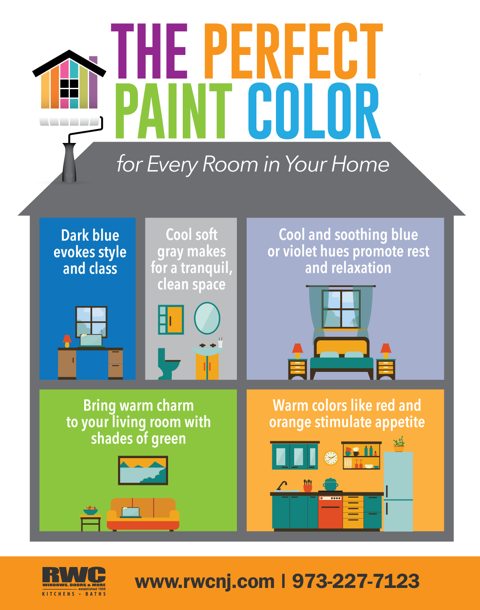
Kitchen
Let’s start with the heart of the home. The kitchen is often where most people start their days. Warm colors such as red and orange are believed to help stimulate one’s appetite and are always a great choice for the kitchen. The colors are also versatile and come in a wide range of shades that can really help your kitchen to pop.
White is also one of the perfect paint colors for walls in a kitchen. It gives the room a fresh and clean feel, as well energizes and brightens it up. It also works as a perfect background color, giving you a chance to play around with other colors for the backsplash, countertops and cabinets.
Bedroom
The bedroom is another important room that requires specific colors on its walls. In this space, you are most likely looking for a place to rest, relax, and get some sound sleep. You may also be looking for a wall paint color that helps evoke some romantic atmosphere. Cool and soothing blue colors are often the most commonly used colors in the bedroom. Muted and pale tones of blue have a lighter shade which creates a soft look that is perfect for a relaxation room.
A cool shade of violet is perfect for the walls as it has a soothing hue that is ideal for evoking spiritual healing and romantic vibes.
Living room
Living room walls are some of the easy ones to play around with. A living room sets the impression of your house to guests. Some of the best paint colors for walls in the living room include dusty pink, velvet-blue, shades of green, and shades of red as well as orange. Most shades of these colors are best at bringing a warm charm to your living room, and when matched up well with antiques and other interior decorations, they can easily leave your guests with a “wow” effect.
Bathroom
Natural paint colors are always the best for bathrooms. They offer a wide range of possibilities and can make even the smallest of spaces to still feel luxurious and serene. A warm and cozy taupe color paired with shades of light pink, green, or blue can be one of the best options for your bathroom. A cool and soft gray also works great in helping conjure up a feeling of tranquility and freshness. A soft turquoise reminiscent of the ocean or beach additionally gives you a serene spa-like environment to enjoy your showers.
Home office
The traditional black and white combination of office’s colors has still not gone out of style. You can opt for this combination or if you want to spice things up a little, consider a nice dark blue color or even a nice shade of red to evoke class and style in your office.
These are some of the perfect paint colors for the various rooms in your home. However, your choice of color for any room should always lean towards your tastes and preferences. The best way to find out the best color for your home’s walls is to see an already completed project in person so that you can have a picture of the end result in your head. Also, here is a list of 29 color ideas for every room in your room that you can check out. All in all, consider consulting a professional from reputable service providers like RWC in New Jersey for advice on the best room color combinations to use in your home.

How to Prepare Your Windows and Doors for Winter [INFOGRAPHIC]
The cold winter months are here; meaning it’s time for you to prepare your windows and doors for the season if you haven’t already done so. The winter season can be a nightmare for you and your family if it finds you unprepared. You will not only have to put up with leaks and drafts, but also with poor insulation resulting in very high energy bills. In most cases, these high bills are due to ineffective windows and doors that act as poor insulators by letting the cold air in and the hot air out.
So, as the winter season sets in, it’s wise to inspect and prepare your windows and doors for winter. Check out our guide on how to get your windows and doors ready for winter: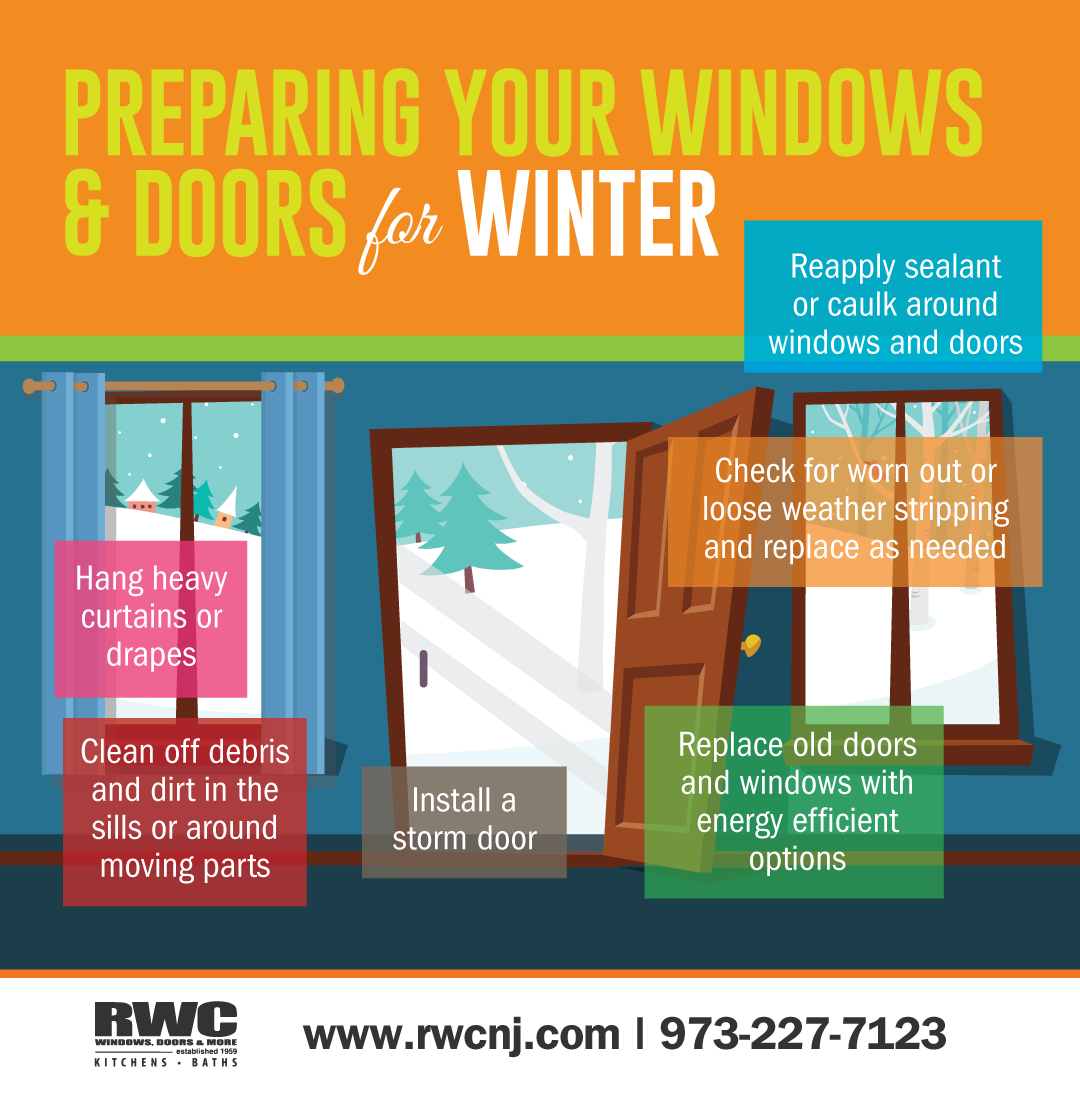
Examine Windows for Dirt and Cracks
- Clean off any debris and dirt in the sills or moving parts of windows and doors. Inspect your doors and windows and clean off any dirt or debris present in their moving parts and sills. Dirt and debris accumulate in these areas and prevent the doors and windows from creating a tight seal. This lowers their insulation performance.
Weather Stripping
- Check the state of weather stripping around doors and windows. Weather stripping may become worn out or ineffective over time, resulting in air leakage and hence insulation inefficiency. Check for any worn-out or loose weather stripping in your home’s openings and reattach or replace them.
Are they Sealed?
- Reapply sealant or caulk around windows and doors. Winterize doors and windows in your home by resealing areas that may have been exposured to sun rays or heavy weather. Such exposure could result in the breakage of the sealant or caulk, hence increasing the potential of leaks and drafts.
Assess Any Damage
- Examine for repairs. Winterizing doors and windows in your home will require you to handle any cracks or damages on them that you may have been postponing. Repairing cracked window panes or wood frames around the windows can help you avoid the risk of moisture leakage during winter. Leakage can cause significant damage to the areas around your windows and doors if ignored for a long time.
Keep Cold Weather Out
- Install a storm door. Consider installing a storm door to the exterior of your front door to add an extra layer of insulation and protection during winter. Some storm doors are built with special coatings or glass that can help reduce energy loss through the front door by more than 50%.
Add Insulation
- Hang heavy curtains or drapes. Drapes or heavy curtains will improve the aesthetic appeal of your home and optimize insulation around windows and doors. Drapes can actually reduce heat loss during winter months by up to 10% when closed by acting as an extra barrier that prevents cold air from the outside from getting into the house.
Out with the Old, in with the New
- Replace your old doors and windows with energy-efficient ones. If your home has single paned glass, they may not offer adequate insulation in cold months. Double or triple-paned glass windows or a fiberglass door, can improve your home’s insulation and save on energy bills.
With these tips, you can easily winterize your doors and windows in readiness for the winter season. Some of the tips are easy to do by yourself, but some require professional help. At RWC New Jersey, we are here to answer any questions you may have concerning winterizing your doors and windows, or help you with any weather proofing assistance you may need for your home. We specialize in windows and doors, and we are your best bet in repairing or replacing your home’s windows and doors for energy efficient ones. Contact us today for consultation or a request a quote for your project for free!
Kitchen Layout Options: The Best Kitchen Layouts for Every Size Space [Infographic]
If you’re a gourmet chef or a culinary novice, a poor kitchen layout can greatly affect your productivity. The size of your space is less important than your layout and frankly, some kitchen layout options are better than others. The key to a great kitchen is creating a functional space; no matter the size. So which kitchen layout is the most functional and what is the best kitchen size? It all depends on what you have to work with. Take a look at some of the best kitchen layouts:
 The Kitchen Work Triangle
-
Good for Medium- and Large-Sized Kitchens
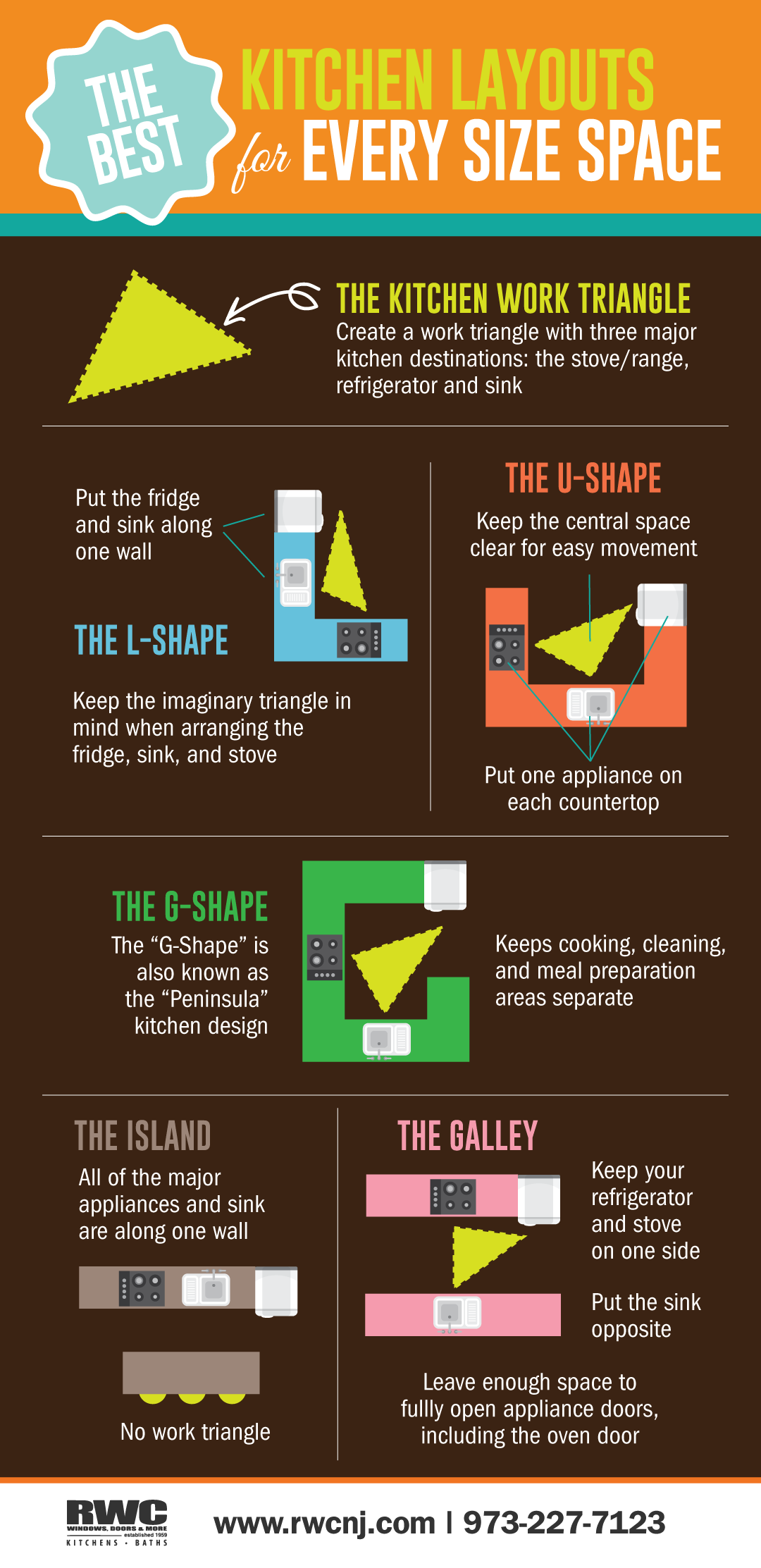
- The work triangle lets you easily get to the three major kitchen destinations: the stove/range, refrigerator, and sink
- It can be set up in most kitchen designs that have at least two built-in countertops
- When you have three surfaces, put one work surface on each wall
- In a galley kitchen, put two work points on one wall and the other on the opposite wall
The U-Shape
- The actual kitchen space for this and most other "shaped" kitchens is square
- Countertops make up the "U" shape
- When drawing up plans, mark the areas for cooking, cleaning, and meal preparation
- Put one aspect of the kitchen in each countertop
- Keep the central space clear for easy movement between areas
The L-Shape
- This kitchen has only two countertops
- Dark spaces tend to form at the bend of the "L." Use lights to avoid these shadows
- Put the fridge and sink along one wall
- Keep the imaginary triangle in mind when arranging the fridge, sink, and stove
- Avoid countertop decor – it'll make the room seem cramped
The G-Shape
- The "G-Shape" is also known as the "Peninsula" kitchen design
- Similar to a U-shape only with an extra tab of counter that partly comes across the front
- Can use the extra countertop as a table top
- You have room to keep the cooking, cleaning, and meal preparation areas separate
- This design supports the work triangle concept
- Add plenty of cabinets for beautiful storage space
- This shape provides plenty of countertop area
The Island Kitchen
- Works well in limited, but not tiny, space
- Put a countertop along just one wall
- Use a kitchen island to add extra workspace and under-counter storage area
- Plan the kitchen around the intended use of the island
- All of the major appliances, as well as the sink, typically go along the same wall as the countertop
- Sinks can be moved to the island, but they often take up most of the island's countertop space
- This design has no work triangle. Instead, most work is done at the main counter
The Galley Kitchen
- It is long and thin with a counter on each side
- Keep your refrigerator and stove on one side
- Put the sink opposite
- Be sure to leave enough space to full open appliance doors, including the oven door
- Install plenty of lighting
The One-Wall Kitchen
- The ultimate space saver
- One of the best small kitchen layouts
- All appliances go along a single wall along with the counter - no triangles here
- Put the sink in between the other major machines
- If there's space for an island or breakfast table, put one in
If you like any of these kitchen layout ideas or want custom kitchen design ideas, give us a call: 973-337-7123. We can discuss and plan your dream kitchen to meet all your wants and needs. Or, visit our showroom in West Caldwell, NJ and speak with one of our experts and schedule your kitchen remodel today.
Battle of the Bathroom: Combining His and Her Bathroom Trends [Infographic]
Men and women often have very different ideas about what makes the perfect bathroom. Some of these differences arise from simple discrepancies in taste, but others come from disparities in habits between men and women in general. That said, men and women aren't different in every way. Both have several overlapping bathroom preferences, especially when it comes to pet peeves. Men and women also tend to prefer setups that have practical usefulness for their daily routines. While some of these things can be addressed by behavioral changes, others are best dealt with by carefully planning the physical design of the bathroom.
Things that Bother Both Men and Women
- Toilet paper holders being left empty
- Spots on the mirror
- Toothpaste in the sink
- Dirty clothes on the floor
What Women Don't Like in Terms of Behavior
- The toilet seat being left up
- The shower not being wiped after use
Bathroom Behaviors that Men Don't Like
- Towels "covered in" makeup
- Counter clutter
- Hair left in the sink, shower, or tub
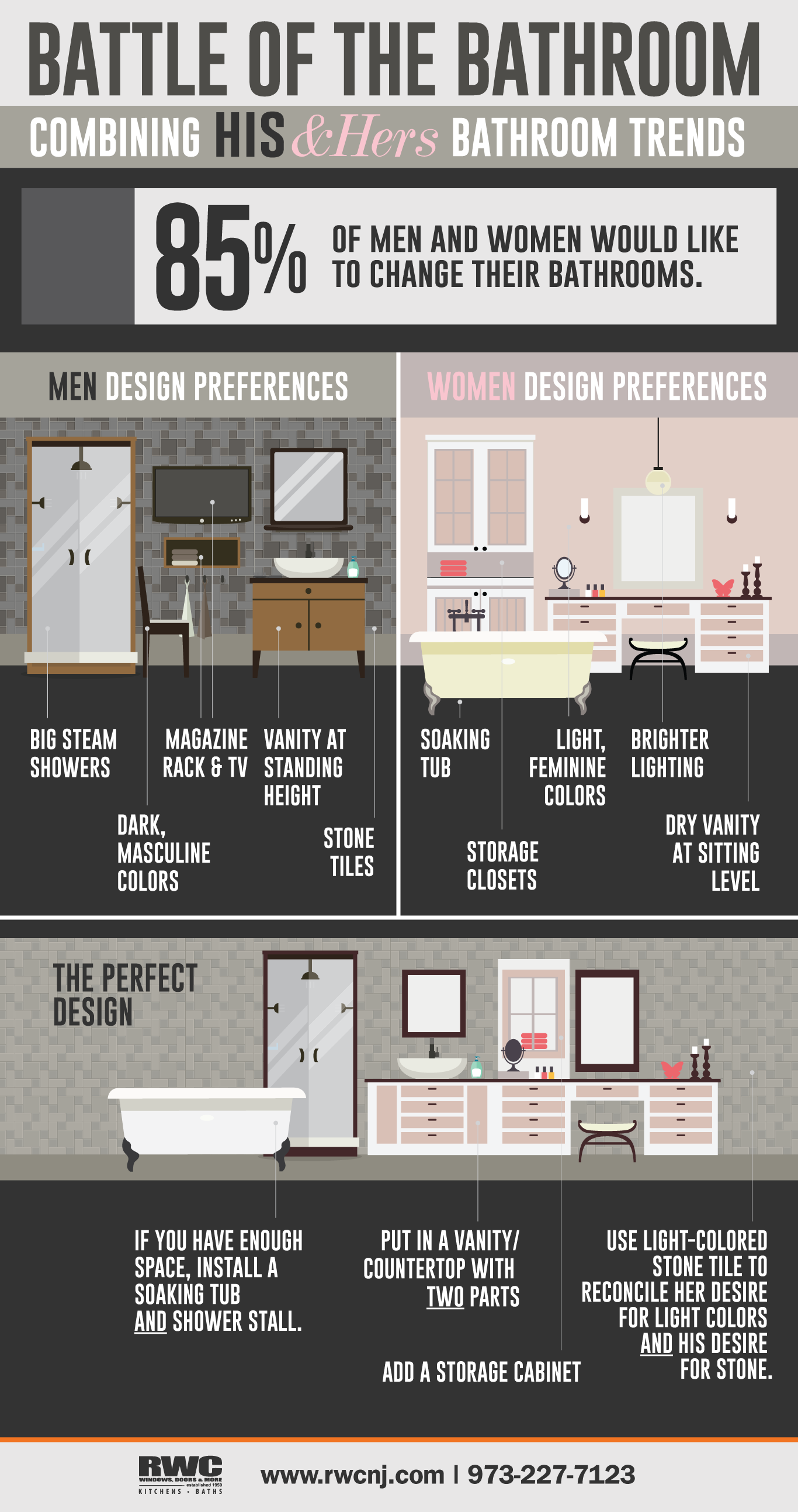
What Men Like in Bathroom Design
- Dark, masculine colors
- Vanity at standing height
- Clean lines
- Big steam showers
- Stone tiles
- A magazine rack
- A TV on a swing arm
What Women Want
- Light, feminine colors
- A dry vanity
- Vanity at sitting height
- Painted cabinets
- Storage closets
- A soaking tub
- Better lighting
How to Reconcile and Peacefully Share a Bathroom
- 85% of men and women would like to change their bathrooms. Combine the best parts of both his and hers bathroom designs to create a compromis
- Use light-colored stone tile to reconcile her desire for light colors and his desire for stone.
- Put in a vanity/countertop that has two parts: One area, with a his and hers bathroom sink duo at standing height; and another part that is dry and positioned for use while sitting.
- Add that storage cabinet. It will help with the countertop clutter that men want to get rid of, yet keep everything handy.
- Remember that men need some storage and working space, too. Make sure there is plenty of room around his sink.
- Put in other storage solutions, such as shelves and towel rods, to help keep clothing and wet towels off the floor.
- Install the biggest counter that is practical.
- If you have enough space, install a soaking tub and shower stall.
- Use a toilet paper holder that can hold multiple rolls or that has a unique, but easy, reloading system.
- Add a hamper to catch dirty clothes.
- Don't hesitate to remodel. One of the things both men and women agree on is the need to change the actual design of the bathroom.
If All Else Fails, Try the Nuclear Option
- Designate separate bathrooms
- Custom design them to match the exact preferences of the intended users
Keeping all of these things in mind will make it much easier to design a bathroom that meets everyone's requirements. While not all people need to make all of the suggested changes, almost everyone can benefit from going ahead with at least some of them. Contact the professionals at RWC Windows, Doors and More to plan your bathroom remodel today.
6 Easy Ways to Spruce Up Your Home's Exterior [Infographic]
When you want to make your home look great, it's time to focus on curb appeal. With a variety of ways, you can update the look of your home on a modest or limited budget. Whether you are selling your home and want to make it more attractive to buyers, or you simply want to improve the look of your property, focus on curb appeal. With the right doors, lighting, and shrubbery, learn how you can change the look of your home with the right improvements.
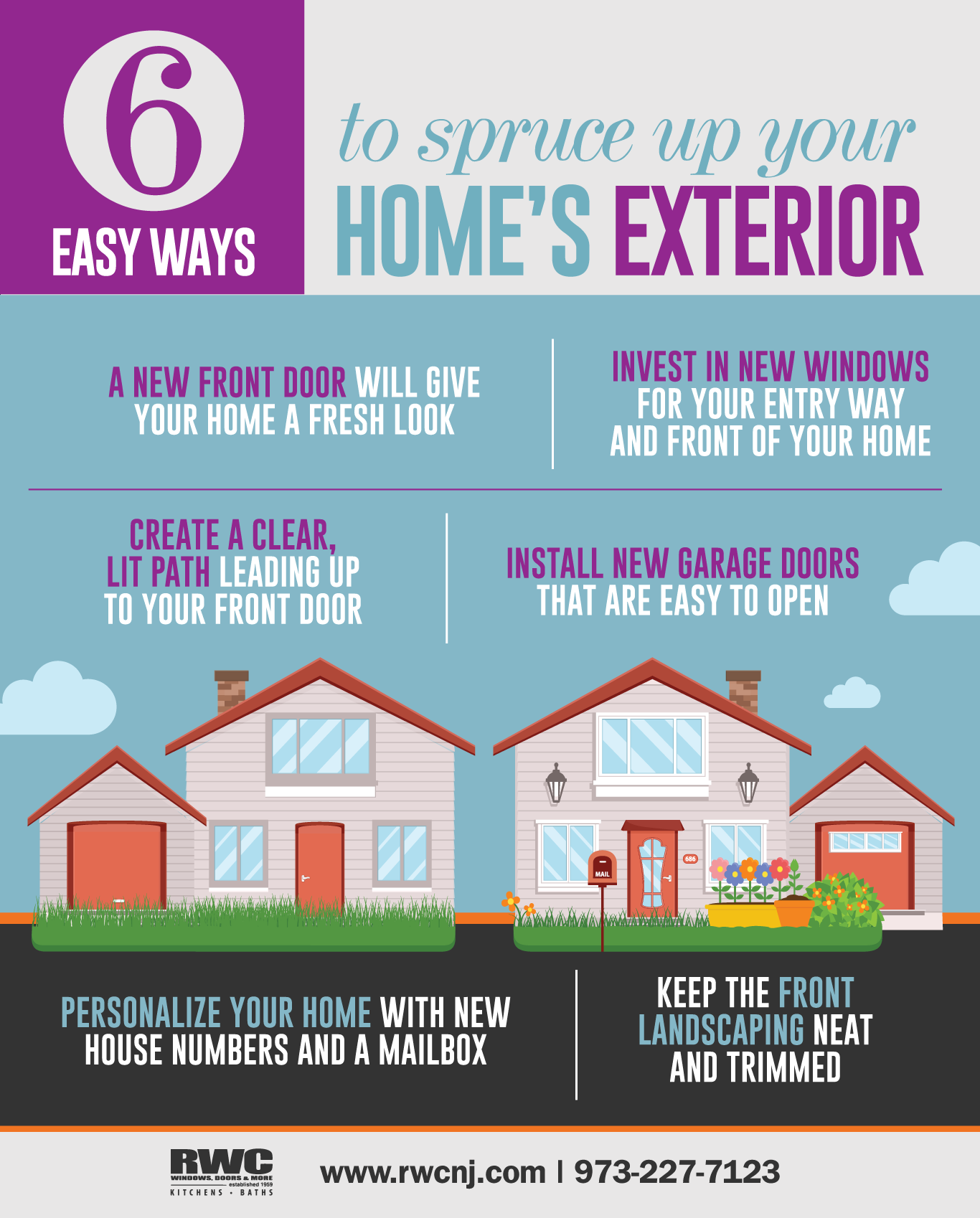
1. Change the Front Door
A new front door is going to give your home a fresh look and improve your overall curb appeal. Take the time to research the style of front door that will work best for your home and find a front door that will work for you.
2. Replace Old Windows
Old, tired looking windows can make your home look disheveled. When you want to improve your curb appeal, invest in new windows for your entry way and the front of your home. In addition, you will make your home more energy efficient once new windows are installed.
3. Renew Your Lighting Scheme
Good lighting makes a big difference in the curb appeal of your home. Look at your home at night with the current lighting turned on. If your entryway doesn’t have a clear, lit path up to your front door, it's time to make changes to your lighting scheme. Replace porch lighting or any other old lighting fixtures to make your home brighter at night.
4. Invest in New Garage Doors
Your garage doors make a bigger overall impact on the look of your home than you may realize. If you have faded garage doors that are difficult to open, your home may appear run down or dated. Keeping your garage doors up to date tells potential home buyers you take care of your home.
5. Install New House Numbers and a Mailbox
Make your home your own by installing new house numbers and a new mailbox on your home. These are two small changes that will give your home a polished look. Check out some of the new LED lit house numbers so that you can see the number of your house, even in the dark. Small accessories will provide the finished look you want when you are focused on the curb appeal of your home.
6. Focus on Landscaping
The final way to make the front of your home look great is to focus on the landscaping. Pull out any tired or weak looking shrubbery and invest in new plantings. Get any trees that are diseased or out of shape pruned appropriately. Focus on perennial gardens to give the front of your home some color during the warm weather months. Keep the front of your home neat and trimmed to boost the curb appeal of your house.
When you want to make the outside of your home look great, it's time to call the professionals at RWC Windows, Doors & More at 973-227-7123 to see how we can help. Our talented staff are ready to talk with you about your home renovation needs. Whether you want to boost the value of your home, or you are trying to prepare your home for sale, we are ready to help you make your home look amazing. For ideas, suggestions, and planning for the exterior of your home, it's time to contact RWC and see how we can help you make your home look great.
7 Home Renovation Mistakes & How to Avoid Them [Infographic]
When done correctly, remodeling projects can transform your home into a beautiful, usable space for your family. However, when home renovations are done wrong, disasters can be the result. Luckily, RWC can teach you everything to know before renovating a house. Use our tips to avoid common home renovation mistakes homeowners make when embarking on a home improvement project. By following our advice, your project will run smoothly and the result will be what you envisioned instead of just an expensive mistake. Scroll down to check out our home renovation infographic with the top 7 common mistakes made!
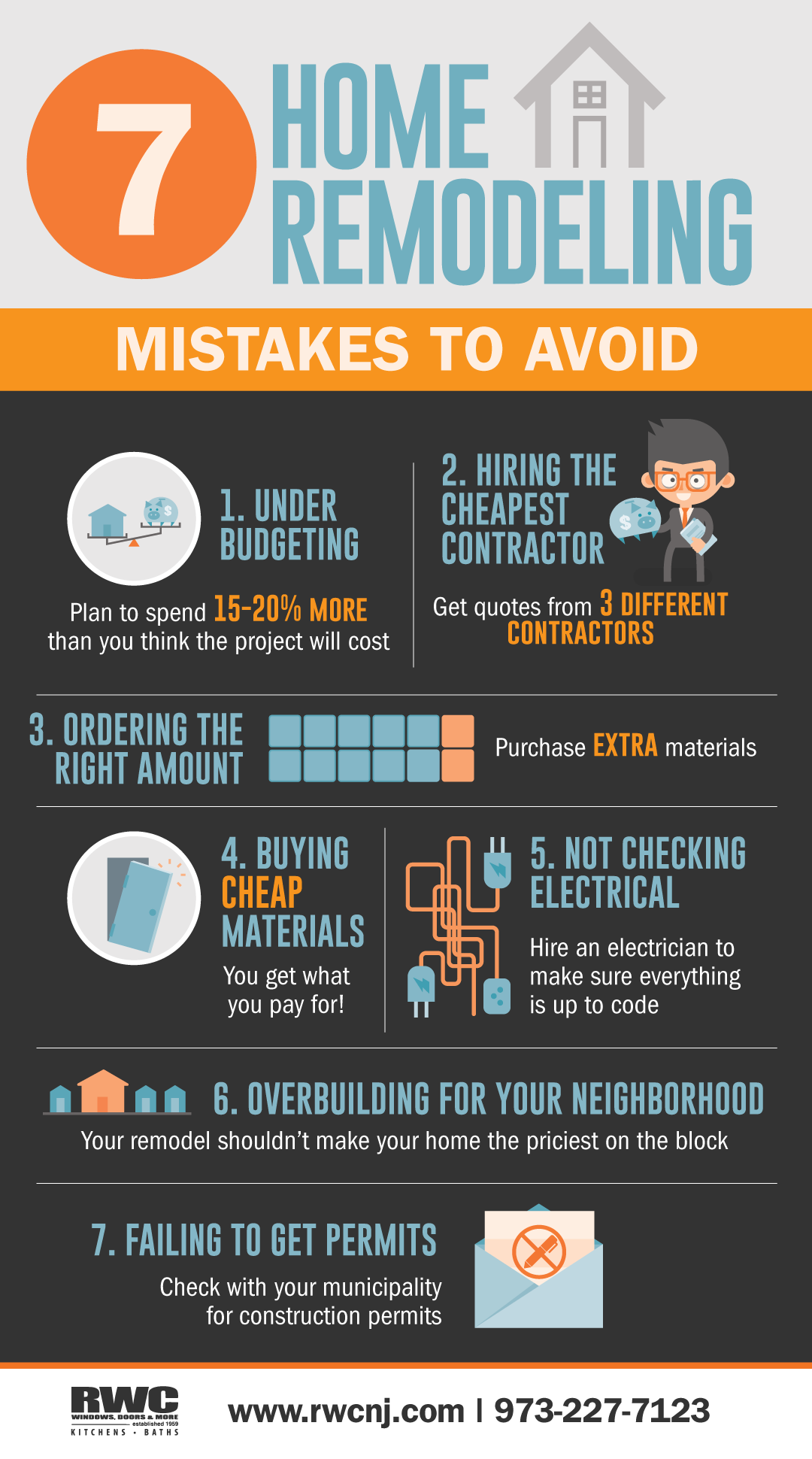 Planning Mistakes
- Choosing the cheapest contractor. Obtain quotes from three different contractors. Quotes should be given in writing and include specific information about products, sizes, permit fees, warranties and the change order process.
- Not expecting the unexpected. Plan to spend 15 or 20 percent more than you think the project will cost. Doing so will allow your budget to absorb unforeseen expenses that always arise during home improvement projects.
- Lack of usable space. Make sure a kitchen or bath renovation has adequate storage and counter space.
- Failing to anticipate a mess. Renovations are chaotic and time-consuming, so expect a mess from the get-go.
- Home renovation timeline is not provided or is inaccurate. Some contractors may overestimate or underestimate their work schedule, causing delays or overcharging.
- Doing 'want to's' instead of 'have to's.' Know the difference between items you must do and items you would like to do.
Construction Mistakes
- Skimping on unseen elements. Moisture barriers, energy efficient windows and other items you may not see will have a big impact on your home's long-term safety and function.
- Failing to get permits. If you don't get a permit, you could incur a fine and your homeowner's insurance may not cover a claim if something happens.
- Neglecting the electric system. Walk through the project with an electrician to ensure outlets are in the right spaces and everything is up to code.
- Ignoring long-term needs. Think about how you might use your home several years in the future instead of in the present.
- Overbuilding for your neighborhood. Your home renovations shouldn't make your home cost substantially more than others in the neighborhood.
Design Mistakes
- Measuring wrong. Make sure measurements are exact to avoid problems with installation.
- Insisting on hardwood. Hardwood may not be the best option for your family. Single-board laminate may be the best choice if you have pets and kids.
- Sticking to trends. Trends are temporary, so look for options that will stand the test of time instead of a short-term fad.
- Buy extra flooring. Having extra materials will allow for mistakes that can happen during installation and accidents that occur down the road.
- Buying cheap materials. You get what you pay for. Consider that when purchasing renovation materials.
- Oversized fixtures. Pick fixtures and features to complement the size of the room.
- Straying from style. Stay true to your home's architectural style to ensure a seamless result.
- Using the wrong paint. Look beyond color and select the right type of paint for your project. Flat paint is best for ceilings while glossy paint works well on trim.
Avoiding these mistakes will help your home renovation project get done quickly, correctly and within your budget. Do your research and plan ahead of time in order to avoid costly errors you'll regret down the road.
NJ Home Remodeling
Unsure where to start? For the best outcome, hire home renovation contractors with decades of experience helping homeowners with kitchen and bath renovations. With nearly 60 years’ experience, RWC is the trusted expert for home improvements. We know all of the home renovation mistakes to avoid and can help you achieve your dream home. Visit our showroom in West Caldwell, NJ, call us at (973) 435-4230 or contact us using our online form for home remodeling quotes and to start planning your renovation today!
The Ultimate Guide to Choosing the Right Door [Infographic]
Choosing The Right Interior Doors & Exterior Doors:
When you think of curb appeal, are you immediately envisioning lush landscaping, white picket fences, and perfect accent colors? If so, you're overlooking one of your home's most notable statement pieces: your front door. Functional and fashionable, your door has a lot of responsibilities. It welcomes visitors in, keeps strangers out, and carries an incredible amount of weight when it comes to the overall aesthetic of your home.
You didn't realize how important your door was before, did you?
Now that you know what a great door can do for you, allow us to unlock the mysteries behind choosing the right one.
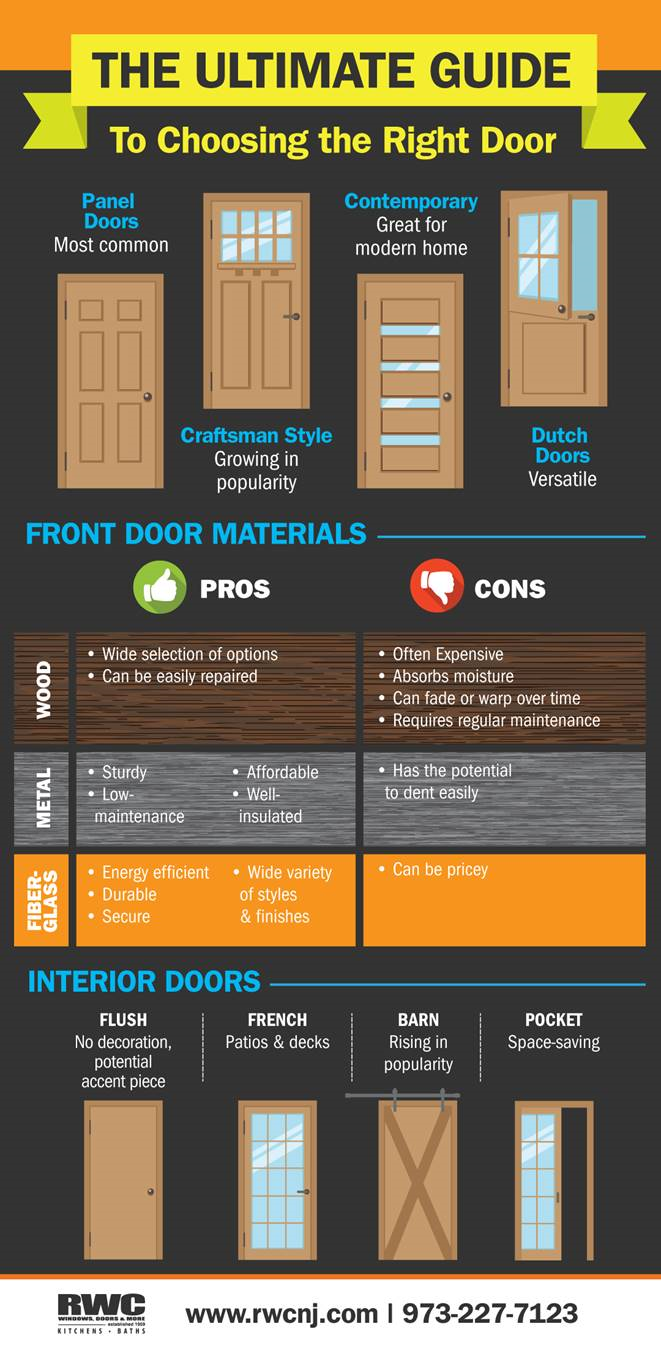
Typical Types of Front Doors
- Panel Doors. Probably the most popular doors on today's homes. They feature smooth, framed sections, surrounding deeply embossed panels. They may feature a window insert (lite.) May be used as interior doors or exterior doors.
- Craftsman Style. Popular in New Jersey because they offer a combination of simple design with complex style. Older, more traditional-style doors are accented by intricate glass work on the sides and at the top, bringing and old-meets-new mentality.
- Contemporary. Modern doors designed with artistic output in mind. Contemporary doors are great for modern homes, and work particularly well with brick houses. They're usually inlaid with elaborate glass.
- Dutch. Designed with a horizontal divide, allowing you to open the top half and let fresh air into your home without opening the entire door
Different Designs for Your Home's Other Doors
- Flush. Solid doors with no decoration, usually used for the interior of homes. Can be painted, stained, or wallpapered.
- Design Tip: If you're not comfortable painting an entire wall with an accent color, start with your door.
- French. Often used for patios and decks or to introduce formal interior spaces, but can also be elaborate front door options. Come in pairs, meeting in the middle and swinging away from each other to open. Usually elaborate, featuring a frame that encases window panels.
- Design Tip: Don't skimp on the details. French doors go great with elaborate hardware that wouldn't work well for some other types of doors. These doors let you step out of your box and get a little exquisite when you're shopping for accessories!
- Barn. Quickly increasing in popularity, these doors are hung from a rod that allows them to slide from side to side. Often used for closets and bathrooms.
- Design Tip: Use reclaimed wood for a home that has a rustic feel and country appeal. This style can also be modern and chic with metal doors and wrought iron rods.
- Pocket. Great space-saving options for New Jersey's older homes that have unique challenges when it comes to style and design. These doors disappear into the wall, maximizing space in even the smallest of places.
- Design Tip: Figure out where you're most frustrated with space, then look online for homes with similar setups so you can see their pocket door solutions.
Main Door Materials
- Wood. Offers a seemingly endless supply of wood species, stains, colors, and finishes.
- Pros:
- Incredibly wide selection of customizable aesthetic options
- Dents, dings, and scratches can be easily repaired
- Cons:
- Often Expensive
- Absorbs moisture -- something to keep in mind in New Jersey
- Can fade or warp over time
- Requires regular upkeep and maintenance
- Pros:
- Metal
- Pros:
- Sturdy
- Low-maintenance
- Affordable
- Well-insulated
- Cons:
- Can be susceptible to rush
- Has the potential to dent easily
- Pros:
- Fiberglass
- Pros:
- Energy efficient
- Durable
- Super secure
- Wide variety of styles and finishes (Can even emulate the appearance of wood)
- Cons:
- Can be pricey
- Pros:
At RWC Windows, Doors & More, we know doors. After all, they're in our name! We've been helping New Jersey homeowners choose the right doors since 1959, and we love what we do. From shopping assistance to full-service installation, our team does it all. Take a look at our full line of front entry door replacement services today!
Guide to Replacement Window Options [Infographic]
So you’ve decided it is time to spruce up your home with replacement windows. You have made a great decision for sure. Replacing the windows in your home can easily bring up its overall value to give you a 90 percent return on your investment. Plus, new windows can boost home efficiency and totally renew curb appeal. However, when you take a look at all of the choices you have before you where window options are concerned, you might feel a little overwhelmed with the process of choosing the right ones.
From varying panes to assorted shapes and styles, it can seem like your choices have no end. Take a look at this guide to replacement windows before you make your final decisions and you will feel much more prepared to find the right options for your home.
Casement and Awning Windows
- Windows crank outward either vertically or horizontally for ease of opening and closing.
- Casement windows work well in areas where windows are needed but there is not a lot of space for access, such as above the kitchen sink.
- Easy to clean thanks to the simplistic design.
- The windows offer a healthy amount of natural light and air flow when needed.
- Casement windows offer the convenience of being able to double as an emergency exit route if necessary.
Bow and Bay Windows
- Usually larger in stature for cosmetic appeal and ample natural light inside of the home.
- Windows are angled from 25 to 45 degrees for a bowed shape.
- Window setup most often consists of a fixed center window and two smaller windows on either side that open, but can have multiple frames in one setup with as many as five windows.
- Bowed window designs allow the inner shape to be used as a sitting area or shelf for added architectural appeal.
- Bowed shape protrudes from the exterior of the house to gather more natural breezes than traditional windows that sit flat against the home.
- Excellent feature for family rooms, formal living rooms, dining areas, and other larger spaces in the home.
- Windows can be casement in style or double-hung.
Double Hung Windows
- Considered to be one of the most traditional replacement window types and suitable for pretty much every room in the house.
- Double-hung windows are easy to keep clean with the ability to open both sashes inward from the frame to reach the outside glass.
- Windows have a long lifespan of about 20 years when maintained well and professionally installed.
- Work well in areas where the height is taller than the available width.
Sliding Windows
- Offer a slim, vertical appearance for a streamlined and modern appearance.
- Windows usually feature sturdy locks.
- Excellent choice in areas where only a small window is needed, such as in the bathroom for ventilation and natural light.
- Feature durable sashes that are reinforced with guides for easy sliding motion and offer the ability to tilt inward for cleaning.
- Sliding windows work well in areas where there is more width available than height, and come in an array of size options.
Custom-Shaped Windows
- Shaped in versatile styles to fit in out-of-the-ordinary shaped spaces in the home, such as above a door.
- These windows are fixed in style, which means they do not open.
- Great way to add cosmetic architectural interest in areas that need a little extra natural light.
When you get a little more familiar with the different types of windows available, it will make your task of finding the right ones for your home an easier feat. While many homeowners take the easiest route and choose the same basic window styles for all of the rooms in the house, most come up with a comprehensive list of different window styles that are suitable for specific areas. If you would like more guidance with choosing the right replacement windows for your New Jersey home, contact RWC for more information.
The Benefits of Making Your Home Energy Efficient [Infographic]
“Energy efficiency” — Is it just a buzz phrase? Or is it your wallet’s best friend?
If you’re leaning towards ‘buzz phrase’, the chances are high that you’re letting money creep through the cracks in your home every single month. A few minor adjustments here and there could put hundreds or thousands of dollars back in your bank account each year. In fact, according to Energy.gov, homeowners in the U.S who take measure to save energy at home experience an average annual savings of $723 to $1,182 as a result of some pretty simple home improvement steps.
Intrigued? Read on to see how you could save some substantial cash each year!
New Jersey is a place where the summers are humid and the winters can get downright cold. In either situation, your best bet is to have a home that’s built to keep your wallet intact. At RWC Windows, Doors & More, we love to help our clients achieve substantial savings with energy-efficient upgrades. Of course, the above figures are just estimates, and you won’t know your true savings until you embark on your own energy efficiency journey. So, what are you waiting for? Get started by contacting our team at RWC Windows, Doors & More today!
Bathroom Remodel Ideas: What You Need To Know Infographic
Thinking about a bathroom renovation? Here are some “must haves” to keep in mind. Following these tips will ensure you create an inviting, relaxing space that’s not only stylish and trendy, but also functional for your family.
If you’re ready to start a bathroom renovation, please get in touch with us today. RWC has nearly 60 years of experience helping homeowners bring their bathroom renovation ideas to life. Call RWC at 973-227-7123.
Sources:
Eye On Housing – Kitchen and Bath Remodeling More Common Than Ever in 2015
Brit+Co – 20 Bathroom Trends That Will Be Huge in 2017
Apartment Therapy – What’s New, What’s Next: Bathroom Design Trends for 2017
https://info.houzz.com/rs/houzz/images/Houzz%26Home2014_U.S..pdf
https://www.diynetwork.com/shows/bath-crashers/10-best-bathroom-remodeling-trends-pictures
https://decoratorswisdom.com/decor/interior-design-trends/bathroom-trends-2016/
https://www.haskellinteriors.com/blog/bathroomtrends/